
Sir William Turner’s Hospital Chapel, Kirkleatham
18th-Century East Window by William Price: Fragile Glass and Enamels
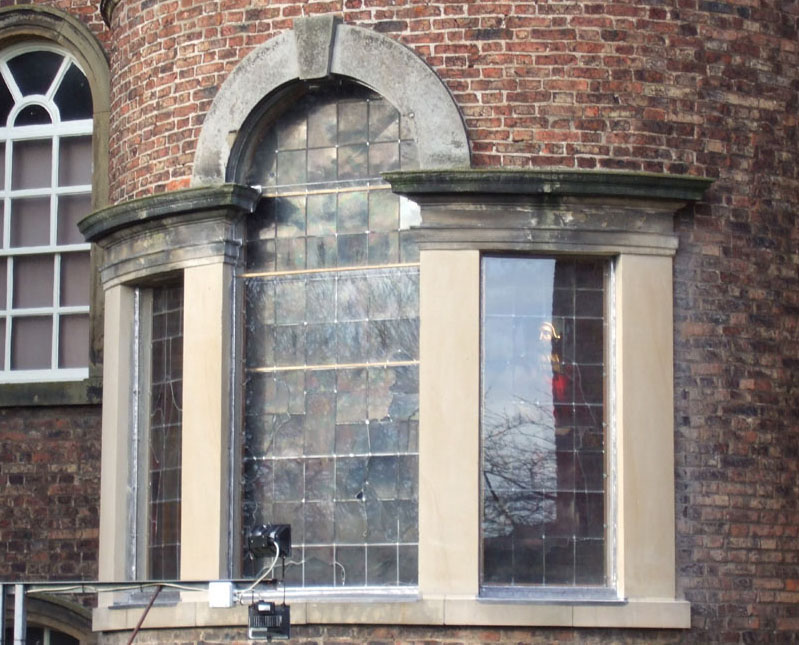
The Liturgical East Window of Sir William Turner’s Hospital Chapel in Kirkleatham, near Redcar, was conserved by Barley Studio in 2010-11. This magnificent eighteenth-century window, with a central light depicting the Adoration of the Magi (after Francesco Sleter) flanked by portraits of Sir William Turner and his brother John, is a rare survival from the period between the medieval and the Gothic Revival; it has been attributed to William Price, one of the most celebrated glass painters of his generation. The window was fixed into a wooden sub-frame with a beautifully carved oak surround.
The window was beautifully painted using paint, enamels and silver stain, on large rectangles of wafer-thin crown sheet glass; every process, from removal to reinstatement, therefore required the utmost care. Although most of the painted glass was in good condition, the lower edges had been badly broken due to cement cills previously cast in situ to the outside of the window. In several areas, the enamel painting (especially areas of blue enamel) had begun to flake away from the glass, due to their different expansion behaviours in changing temperatures.
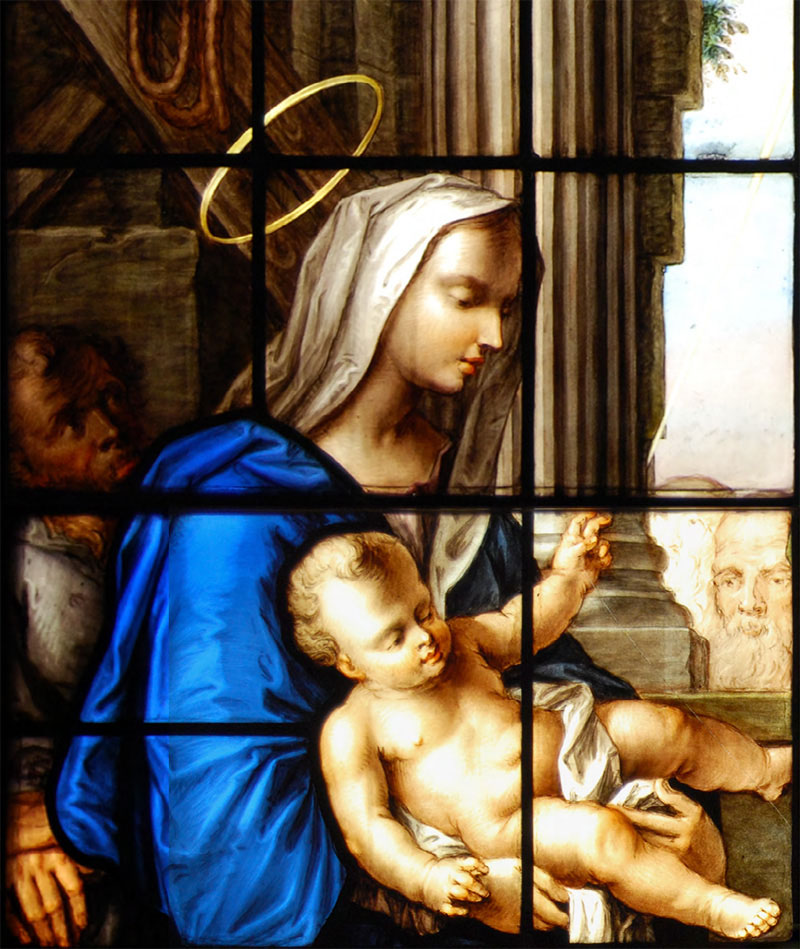
All of the tiny glass fragments embedded in the cement were carefully collected and edge bonded back into place wherever possible; new painted insertions were made where necessary. Small areas of lost enamel were disguised by cold painting using conservation grade oil paints. The lead network, although somewhat fragile, was thought to be original, and so was retained and repaired as far as possible. Breaks in the lead and solder joints were repaired and strengthened using copper gauze, soldered in place to bridge across the breaks.
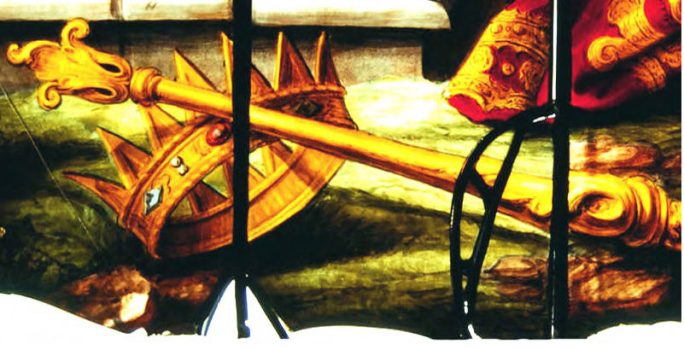
Detail before conservation showing damage to lower edge.
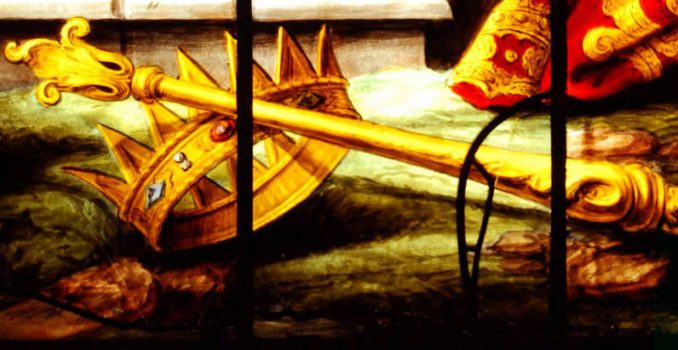
Detail after conservation with fractures bonded and new glass infills
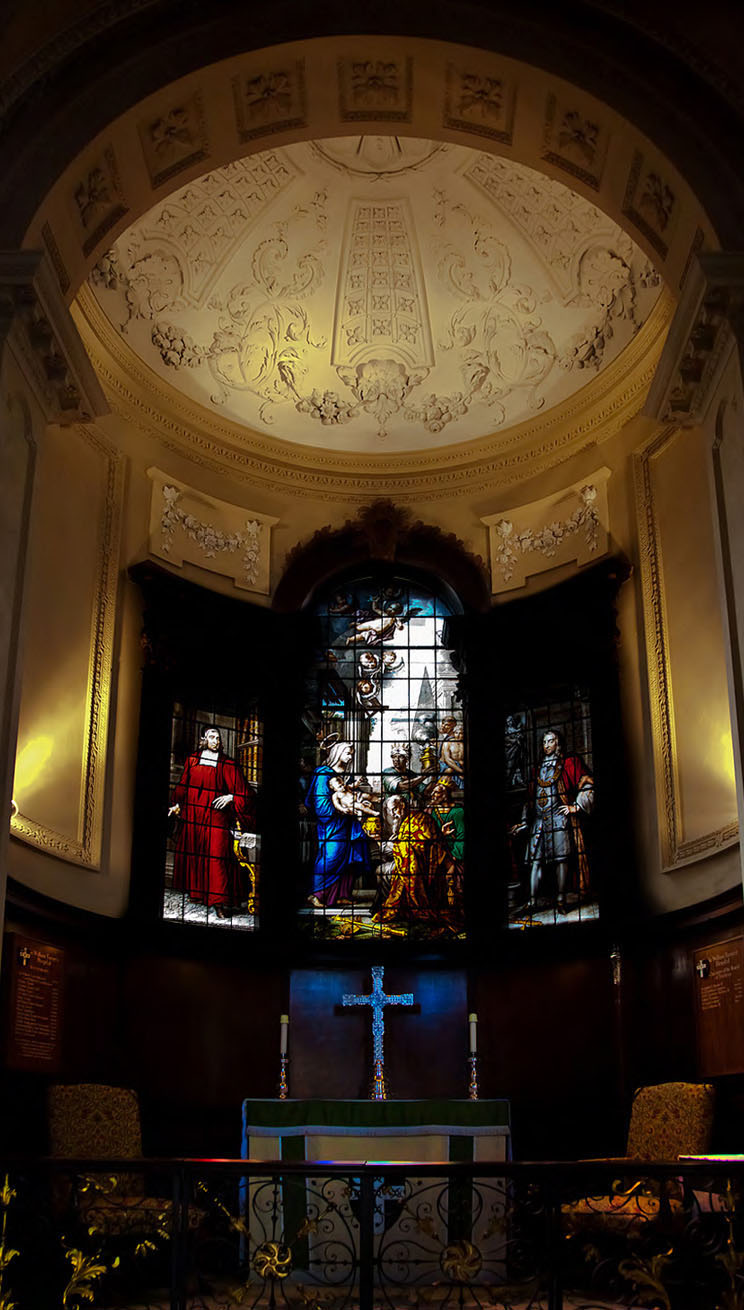
In order to preserve both the original enamel painting and our conservation interventions from the effects of moisture and temperature changes, the window was re-installed with external environmental protective glazing. The window was originally fixed from the exterior into a rebated oak sub-frame, which was itself replaced as part of the conservation work. Fixing the stained glass into the rebate meant that the glass could not be moved forward into the building; however, the renewal of the timber sub-frame offered the opportunity to build in ventilation slots such that the interspace between the window and the external glazing would be ventilated to the interior of the building. This ventilated ‘isothermal’ system will keep the glass both dry and at a more even temperature than previously achievable.
The stained glass panels were framed in manganese bronze, with bronzed brass support bars attached following the lines of the original support framework, and fitted into the rebate of the new oak frame. Our new external protective glazing was then also framed in manganese bronze, in order to fix these panels within the stonework reveal to the exterior of the stained glass, with lead tape around the panels forming a waterproof seal to the stone.
We use cookies on our website to give you the most relevant experience by remembering your preferences and repeat visits. By clicking “Accept All”, you consent to the use of ALL the cookies. However, you may visit "Cookie Settings" to provide a controlled consent.
Manage consent
Privacy Overview
This website uses cookies to improve your experience while you navigate through the website. Out of these, the cookies that are categorized as necessary are stored on your browser as they are essential for the working of basic functionalities of the website. We also use third-party cookies that help us analyze and understand how you use this website. These cookies will be stored in your browser only with your consent. You also have the option to opt-out of these cookies. But opting out of some of these cookies may affect your browsing experience.
Necessary cookies are absolutely essential for the website to function properly. These cookies ensure basic functionalities and security features of the website, anonymously.
| Cookie | Duration | Description |
|---|---|---|
| cookielawinfo-checkbox-analytics | 11 months | This cookie is set by GDPR Cookie Consent plugin. The cookie is used to store the user consent for the cookies in the category "Analytics". |
| cookielawinfo-checkbox-functional | 11 months | The cookie is set by GDPR cookie consent to record the user consent for the cookies in the category "Functional". |
| cookielawinfo-checkbox-necessary | 11 months | This cookie is set by GDPR Cookie Consent plugin. The cookies is used to store the user consent for the cookies in the category "Necessary". |
| cookielawinfo-checkbox-others | 11 months | This cookie is set by GDPR Cookie Consent plugin. The cookie is used to store the user consent for the cookies in the category "Other. |
| cookielawinfo-checkbox-performance | 11 months | This cookie is set by GDPR Cookie Consent plugin. The cookie is used to store the user consent for the cookies in the category "Performance". |
| viewed_cookie_policy | 11 months | The cookie is set by the GDPR Cookie Consent plugin and is used to store whether or not user has consented to the use of cookies. It does not store any personal data. |
Functional cookies help to perform certain functionalities like sharing the content of the website on social media platforms, collect feedbacks, and other third-party features.
Performance cookies are used to understand and analyze the key performance indexes of the website which helps in delivering a better user experience for the visitors.
Analytical cookies are used to understand how visitors interact with the website. These cookies help provide information on metrics the number of visitors, bounce rate, traffic source, etc.
Advertisement cookies are used to provide visitors with relevant ads and marketing campaigns. These cookies track visitors across websites and collect information to provide customized ads.
Other uncategorized cookies are those that are being analyzed and have not been classified into a category as yet.
Loading...
Loading...