
St Mary's Church, Community and Conference Centre, Sheffield
Pilgrimage – East Window (3.0m x 6.5m) and Two Sculptures (each 2.0m high)
This work is a meditation on the human and the divine through the theme of pilgrimage, represented by two sculpted copper figures and a large, five-light stained glass window. ‘Pilgrimage’ was commissioned for this multi-purpose space by Canon Julian Sullivan following the success of my scheme at Beverley Minster, also on the theme of Pilgrimage. It was dedicated by the Archbishop of York, The Most Reverend and Right Honourable Dr John Sentamu, in March 2009.
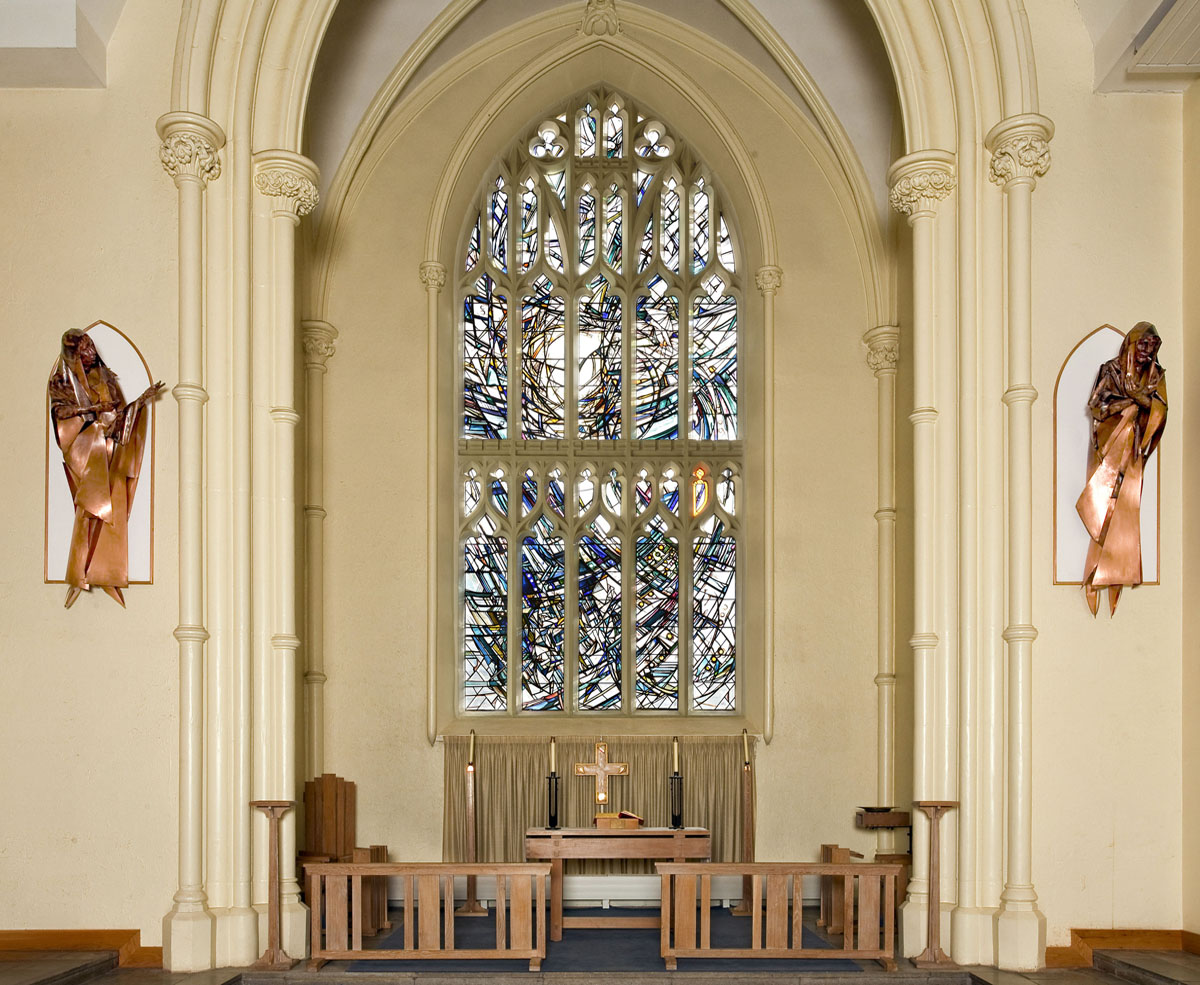
Psalm 84 (How amiable are thy tabernacles, O LORD of hosts!) provides the starting point for this exploration. The Psalmist grieves at being far from God’s house, the temple of Zion. Weak with longing to reach his destination, and in the company of fellow pilgrims, he is filled with awe because his entire life and being cries out for the Living God.
East window
Light, colour and dramatic geometric swirls represent the pathways of the pilgrims and reflect the rich symbolism in the psalm. The journey begins in the bottom left corner with a pathway that sweeps diagonally across the lower half of the window. This represents the dry valley in the psalm. Through this treacherous landscape two adults and a child can be seen making their way towards the House of God.
As the pilgrims pass through the valley a spring appears and droplets of rain fall, creating refreshing pools on the pathway, signifying that their minds are strengthened and illuminated by God, and that the valley will grow less hostile with the autumn rains.
The lush green area symbolises the sense of hope found at the meeting point between the earthly pathway and the spiritual pathway. This is where each pilgrim stands before God hoping to advance their temporal journey and continue it as a spiritual journey towards Zion.
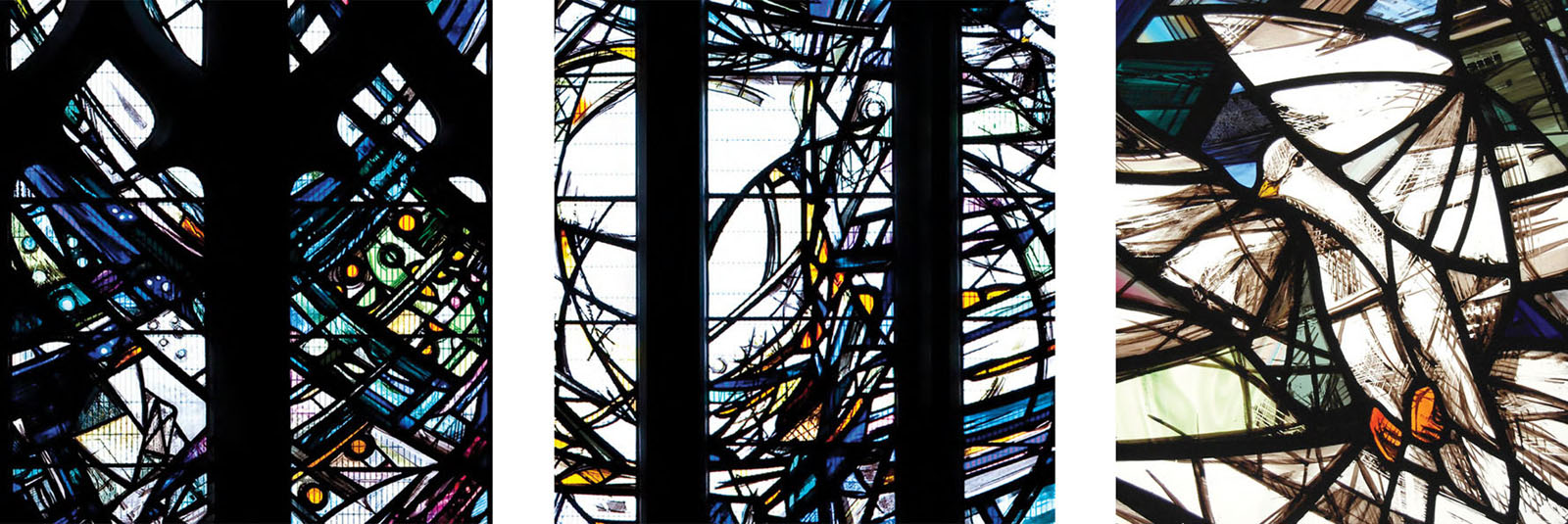
In the upper half of the window the colours of bright orange, yellow and gold announce the heart of the composition. Here is the House of God, a place of security inhabited by the Dove of Peace. The sense of security is heightened by the cross-hatched paintwork which resembles a nest and reflects the words of the psalm: even the sparrow has found a home and the swallow a nest for herself where she may lay her young.
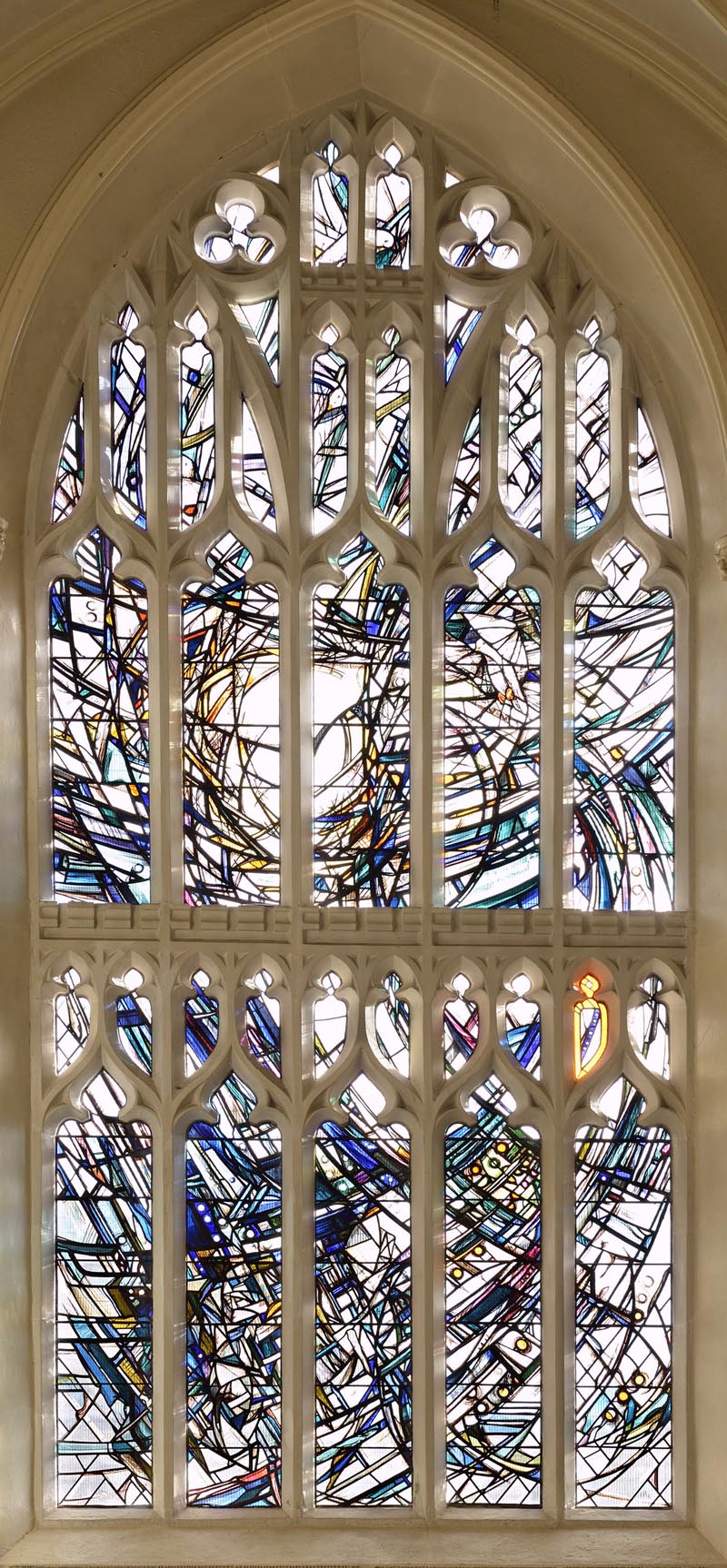
In the upper section the two paths speak of the cross of sacrifice and redemption and of change and transformation. The swirling circles which dominate the design, the cross itself and the bright light at the heart of the composition represents the Trinity. Radiating upwards from the House of God, numerous triangular fragments of the Holy Spirit scatter out from the apex towards the wider universe.
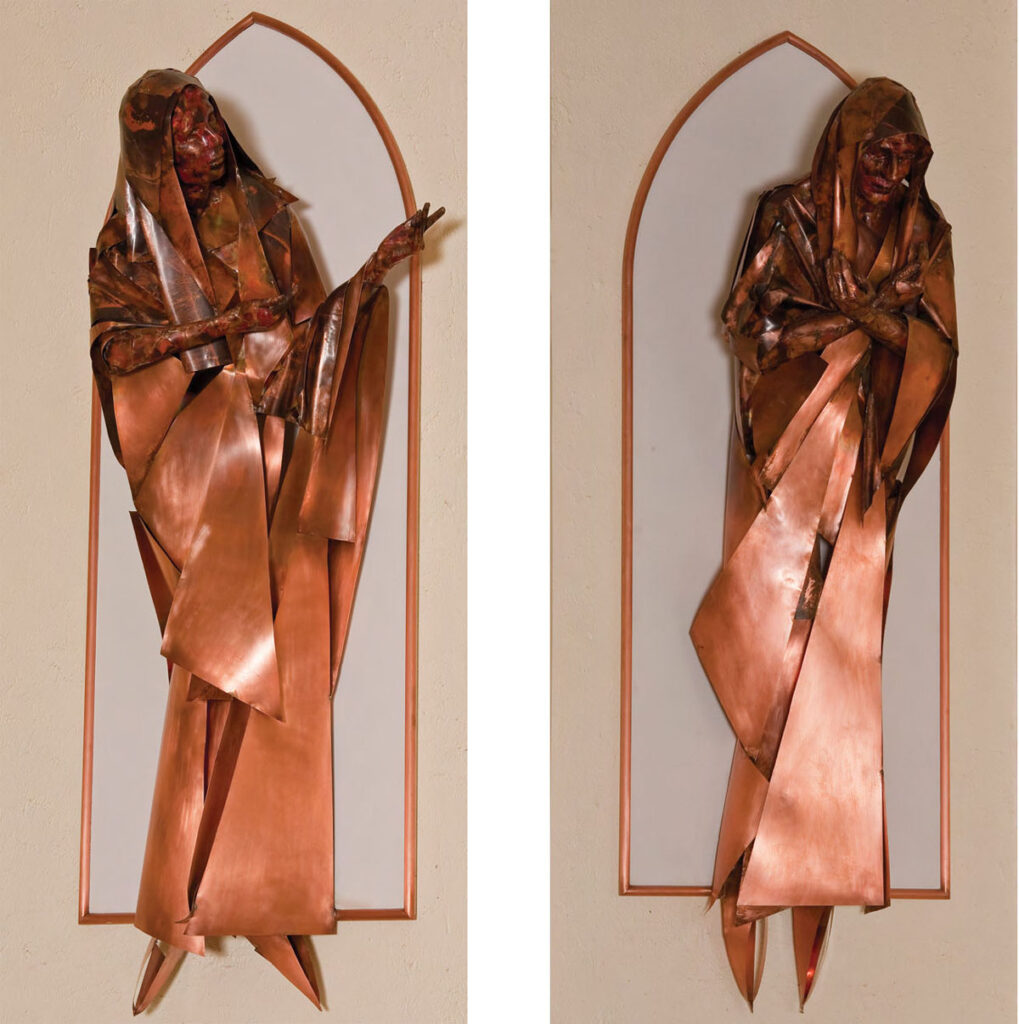
Two Sculptures
On each side of the moulded arch framing the sanctuary are two copper sculptures. These life-size figures of a man and a woman are intended to bring the meaning and abstract language of the stained glass much closer to our own human scale and physicality. They invite us to consider the journey we are making through life and encourage us to question the paths we choose.
Emerging from triangles of copper at their base, the figures become more densely modelled and intricate as these elemental forms rise. Ultimately they transform into complex, complete beings as they make their pilgrimage towards truth and spiritual understanding. The triangular shapes not only symbolise the threefold nature of God – the divine love that created us, redeems us and gives us form – but also remind us of the relationship between the sculpture and the shards of glass in the window.
The sculptures and the window have an intricate three-way relationship. One figure gestures towards the images and symbols of pilgrimage and creation in the stained glass whilst the other, in a more introspective pose, invites us to meditate on what we see in the window and apply it to ourselves; the inner journey of faith can lead us to religious truth through reflection and meditation.
The artwork’s central message is one of Faith and Love – the tenets upon which all pilgrimages are based.
We use cookies on our website to give you the most relevant experience by remembering your preferences and repeat visits. By clicking “Accept All”, you consent to the use of ALL the cookies. However, you may visit "Cookie Settings" to provide a controlled consent.
Manage consent
Privacy Overview
This website uses cookies to improve your experience while you navigate through the website. Out of these, the cookies that are categorized as necessary are stored on your browser as they are essential for the working of basic functionalities of the website. We also use third-party cookies that help us analyze and understand how you use this website. These cookies will be stored in your browser only with your consent. You also have the option to opt-out of these cookies. But opting out of some of these cookies may affect your browsing experience.
Necessary cookies are absolutely essential for the website to function properly. These cookies ensure basic functionalities and security features of the website, anonymously.
| Cookie | Duration | Description |
|---|---|---|
| cookielawinfo-checkbox-analytics | 11 months | This cookie is set by GDPR Cookie Consent plugin. The cookie is used to store the user consent for the cookies in the category "Analytics". |
| cookielawinfo-checkbox-functional | 11 months | The cookie is set by GDPR cookie consent to record the user consent for the cookies in the category "Functional". |
| cookielawinfo-checkbox-necessary | 11 months | This cookie is set by GDPR Cookie Consent plugin. The cookies is used to store the user consent for the cookies in the category "Necessary". |
| cookielawinfo-checkbox-others | 11 months | This cookie is set by GDPR Cookie Consent plugin. The cookie is used to store the user consent for the cookies in the category "Other. |
| cookielawinfo-checkbox-performance | 11 months | This cookie is set by GDPR Cookie Consent plugin. The cookie is used to store the user consent for the cookies in the category "Performance". |
| viewed_cookie_policy | 11 months | The cookie is set by the GDPR Cookie Consent plugin and is used to store whether or not user has consented to the use of cookies. It does not store any personal data. |
Functional cookies help to perform certain functionalities like sharing the content of the website on social media platforms, collect feedbacks, and other third-party features.
Performance cookies are used to understand and analyze the key performance indexes of the website which helps in delivering a better user experience for the visitors.
Analytical cookies are used to understand how visitors interact with the website. These cookies help provide information on metrics the number of visitors, bounce rate, traffic source, etc.
Advertisement cookies are used to provide visitors with relevant ads and marketing campaigns. These cookies track visitors across websites and collect information to provide customized ads.
Other uncategorized cookies are those that are being analyzed and have not been classified into a category as yet.
Loading...
Loading...