
Royal Air Force Club, London
‘Celebrating Women in the RAF’ – Stained Glass and Sculpture
(4.1m x 1.8m) 2018
The windows are located in the former Anteroom to the Ladies’ Bar and Lounge, the area to which ladies were restricted from the Club’s opening to the 1960s. This was the inspiration to two Trustees, Gp Capt Tony Banks and Wg Cdr Michael Gilbert, to propose the idea of creating two stained glass windows to commemorate “women in the service of the Royal Air Force”.

My design is inspired by the iconic image of the American factory worker, Rosie the Riveter. The idea of the female worker holding the air forces together through the fixing of rivets becomes a metaphor for women in the service of the RAF and the development of their role, from a separate ‘female’ service to their present fully integrated position; from factory workers to pilots.
Thus in both new stained glass windows, lines of rivets at eye level across the base of the window provide lenses through which images of women serving the RAF can be viewed, illustrating the dramatic evolution of their roles, both in uniform and as civilians, from window 1 to window 2. My design also captures the graphic nature of World War II posters, with block colours and bold lines.
The windows were officially unveiled by Her Majesty The Queen, Patron of the Club, on 17 October 2018 during a special visit to mark the centenary of both the RAF and the RAF Club.

Window One: 1918 – 1945
The window to the left celebrates the variety of vital supporting roles that women have provided to the Royal Air Force, both while serving in uniform and as civilians.
At the lower left, the steering wheel of a WWI Crossley tender symbolises the way war opened up a range of opportunities previously the province of men, such as driving and servicing lorries, motorcycles and cars. To the right, the Operations Room clock references the ever-expanding role of women in radar installations, operations rooms and flying control. The hands of the clock are set at 11.01 am, for it was at this time on 15th September 1940, with Churchill present at AVM Park’s 11 Group, the Luftwaffe launched what it believed would be the knockout blow. In the event, after a hard day’s fighting, it was the Germans who were repulsed on what is now commemorated as Battle of Britain day.
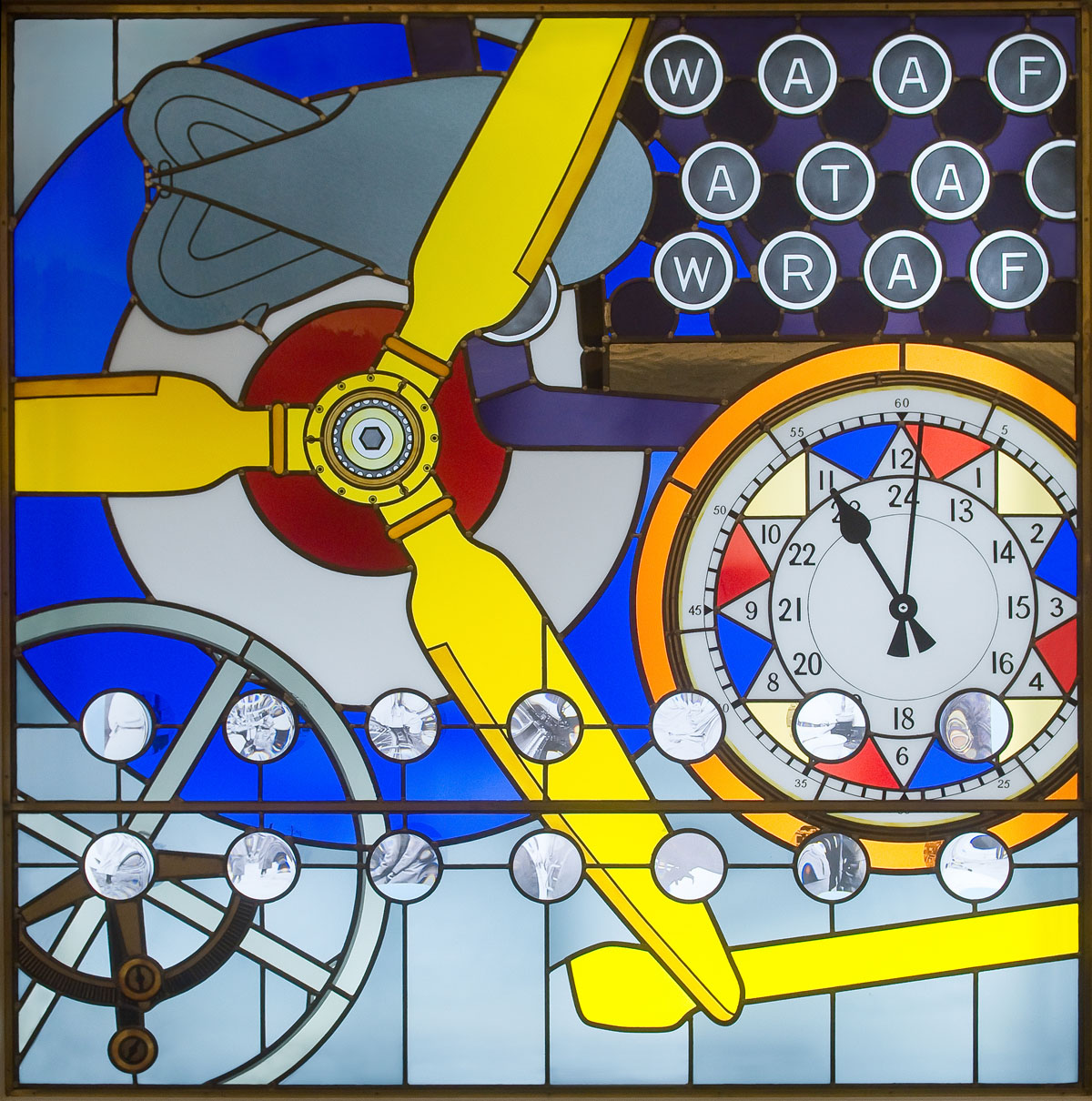
Above left, the Spitfire propeller stands for the essential part played by women in manufacturing and maintaining aircraft, and also references related roles from parachute packing to the delivery of aircraft to squadrons by the civilian pilots of the ATA. The propeller is centred on the red, white and blue roundel of the Royal Air Force. To the top left is a barrage balloon, not only manufactured by women but also operated by them on barrage balloon sites. To the top right, the typewriter signifies the vital administration and support roles taken by women. The keys show the initials of the women’s services, the WRAF in WWI, the WAAF in WWII, and finally the vital airborne ‘delivery service’, the civilian ATA.

Window Two: Post-War to the Present Day
The second window celebrates the fact that women are no longer seen simply as a resource called on in times of war, but are now fully integrated into the Royal Air Force.
The rotor of the Merlin helicopter forms a link across the two windows; the Merlin was flown by the first female to be awarded the Distinguished Flying Cross (DFC) during Operation TELIC in Iraq in June 2007. To the right is a Hercules, the aircraft flown by the RAF’s first female pilot in an operational role from June 1991, marking the culmination of a process pioneered by the female pilots of the ATA.
Above left, and overlaid with the Hercules propeller, the Red Cross represents the female medical role. Commencing with nursing, when the Princess Mary’s Royal Air Force Nursing Service was inaugurated in June 1918, and uniquely remaining in being between the wars, the role has since expanded to include casualty evacuation and front-line medical provision, with female doctors and nurses working equally alongside their male counterparts.
At the top of the window is an airfield with two runways, with a drum to their left. Resting on the wing of the Hercules, the drum underlines the importance of music to the esprit de corps of the armed forces. The Central Band of the Women’s Royal Air Force was established in 1949 but sadly fell victim to defence cuts in 1972. However, in 1990 the RAF became the first Service to recruit women to form mixed bands, and today they form a growing proportion of RAF musicians.
To the right, a 617 Squadron Tornado celebrates the RAF’s first female pilot, who joined 617 Squadron in 1994, and also the first fastjet RAF squadron (12 Squadron) to be commanded by a woman in January 2015.
Behind the Lenses
Behind each of the 28 lenses (rivets) in the two main horizontal rows, an image is visible, creating a riveting panorama of photographs and posters illustrating women’s roles from the RAF’s formation to the present day. The images were sourced from the Air Historical Branch and The Directorate of Public Relations, RAF, the RAF Museum, the Imperial War Museum, and from Flt Lt Kirsty Moore.
The images behind the left window show the evolution of female roles from simple typewriter to skilled air mechanic, radar operator, and ATA pilot; while those behind the right window chart the transformation in the status of women in the RAF, now fully integrated and filling all roles in the service.


Between the Windows
Between the windows is a depiction of the George Cross, a tribute to the extraordinary bravery of Daphne Pearson and Noor Khan (in the latter case resulting in her murder in Dachau).
The ribbon, being between the typewriter and the Merlin rotor, serves to remind us that women’s progression from their strictly limited role of a century ago to the fully operational role today has also exposed them to the hazards of war, as underlined by awards of the Military Medal in the last war, and of the DFC in 2007.
We use cookies on our website to give you the most relevant experience by remembering your preferences and repeat visits. By clicking “Accept All”, you consent to the use of ALL the cookies. However, you may visit "Cookie Settings" to provide a controlled consent.
Manage consent
Privacy Overview
This website uses cookies to improve your experience while you navigate through the website. Out of these, the cookies that are categorized as necessary are stored on your browser as they are essential for the working of basic functionalities of the website. We also use third-party cookies that help us analyze and understand how you use this website. These cookies will be stored in your browser only with your consent. You also have the option to opt-out of these cookies. But opting out of some of these cookies may affect your browsing experience.
Necessary cookies are absolutely essential for the website to function properly. These cookies ensure basic functionalities and security features of the website, anonymously.
| Cookie | Duration | Description |
|---|---|---|
| cookielawinfo-checkbox-analytics | 11 months | This cookie is set by GDPR Cookie Consent plugin. The cookie is used to store the user consent for the cookies in the category "Analytics". |
| cookielawinfo-checkbox-functional | 11 months | The cookie is set by GDPR cookie consent to record the user consent for the cookies in the category "Functional". |
| cookielawinfo-checkbox-necessary | 11 months | This cookie is set by GDPR Cookie Consent plugin. The cookies is used to store the user consent for the cookies in the category "Necessary". |
| cookielawinfo-checkbox-others | 11 months | This cookie is set by GDPR Cookie Consent plugin. The cookie is used to store the user consent for the cookies in the category "Other. |
| cookielawinfo-checkbox-performance | 11 months | This cookie is set by GDPR Cookie Consent plugin. The cookie is used to store the user consent for the cookies in the category "Performance". |
| viewed_cookie_policy | 11 months | The cookie is set by the GDPR Cookie Consent plugin and is used to store whether or not user has consented to the use of cookies. It does not store any personal data. |
Functional cookies help to perform certain functionalities like sharing the content of the website on social media platforms, collect feedbacks, and other third-party features.
Performance cookies are used to understand and analyze the key performance indexes of the website which helps in delivering a better user experience for the visitors.
Analytical cookies are used to understand how visitors interact with the website. These cookies help provide information on metrics the number of visitors, bounce rate, traffic source, etc.
Advertisement cookies are used to provide visitors with relevant ads and marketing campaigns. These cookies track visitors across websites and collect information to provide customized ads.
Other uncategorized cookies are those that are being analyzed and have not been classified into a category as yet.
Loading...
Loading...