
St Thomas of Canterbury Church, Greatford, Lincolnshire
St Thomas Becket – South Nave Aisle
(1.1m x 2.8m) 2015
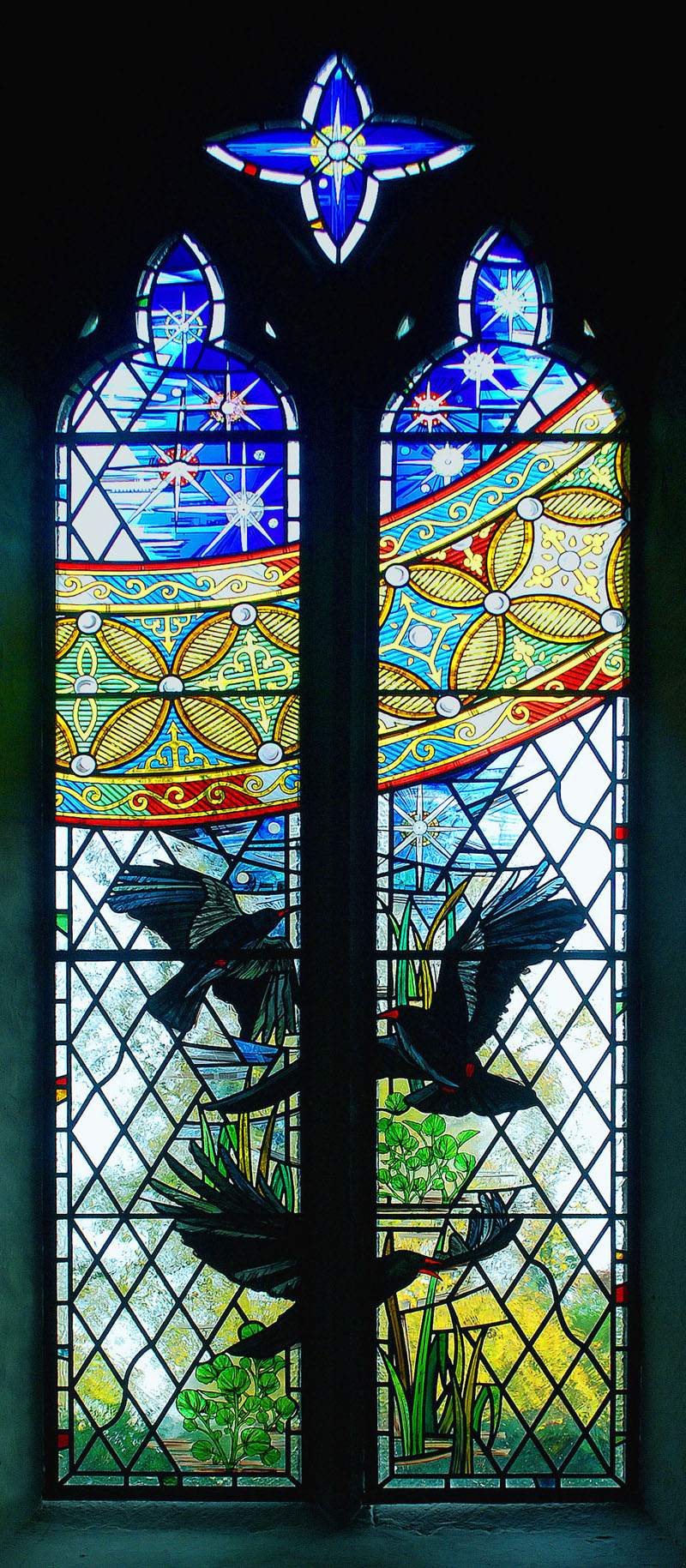
Greatford Church requested a non–figurative representation of their Patronal saint, St Thomas of Canterbury, in a design incorporating significant areas of clear glass to maintain the light coming through this south-facing window. The brief suggested that the twelfth-century Becket reliquary casket, held in the Victoria and Albert Museum, London, should be a primary source of inspiration. My modern interpretation of Becket is inspired also by the connections between St Thomas the Martyr and the church of St Thomas in Greatford.
At the base of the window are three choughs, which appear on Becket’s coat of arms (indeed, in heraldry, choughs are known as ‘beckits’). The choughs are depicted flying over the watercress fields and reed beds of the River Glen around Greatford. Watercress was grown commercially near Greatford Hall, and has long been known for its health and healing properties; in medieval Europe it was used as a salve to treat sword wounds. Watercress is thought to have been one of the ‘bitter herbs’ eaten at Passover [Exodus 12:8], a reminder of the bitterness of sin and symbolic of the reason that Jesus had to die. The reed is a symbol of Christ’s Passion, as on the Cross He was offered a vinegar-soaked sponge on the end of a reed [Matthew 27:48]; this humiliation of greatness is echoed in Becket’s martyrdom, having displeased King Henry II.
The zig-zag shape formed by the three choughs draws the eye upwards to the central motif of the window, a sweeping band of elaborate geometric patterning taken from the embroidered apparel of the amice, in the collection of Becket’s vestments in Sens Cathedral. The apparel represents both Becket himself and the manner of his martyrdom (so vividly depicted on the reliquary casket), as it would have been worn around his shoulders and covered his neck. The elaborate Becket reliquary casket is beautifully decorated with scenes of Becket’s martyrdom, his burial, and the raising of his soul to heaven. The two angels holding Becket’s shroud and escorting his soul to heaven are particularly inspiring, and are interpreted here through the upwards sweep of the design from the more representational elements at the base of the window towards the multi-coloured stars at the top of the window, drawn from the background details of the reliquary casket, and representing heaven.
I have made deliberate use of strong colours in the upper part of the window in order to soften the strong light entering this South-facing window, balanced with the much lighter lower part addressing the practical need for light coming through the window. The colours used throughout the window, blue, red, green, and yellow, are drawn from the enamels used on the reliquary casket, which are also the colours of the apparel of the amice.
The bold nature of my design reflects the strength of Thomas Becket’s character. Both light and colourful, and with a traditional foundation in the techniques of its creation, the abstract feel of the window complements rather than competes with the other stained glass windows in the church. The overarching narrative within the window is the transition from the earthly life, rooted in Greatford and its church, to St Thomas in the heavenly realm. The apparel of the amice is the pivotal element, celebrating Becket’s achievements as archbishop that ultimately led to his martyrdom and canonisation.
We use cookies on our website to give you the most relevant experience by remembering your preferences and repeat visits. By clicking “Accept All”, you consent to the use of ALL the cookies. However, you may visit "Cookie Settings" to provide a controlled consent.
Manage consent
Privacy Overview
This website uses cookies to improve your experience while you navigate through the website. Out of these, the cookies that are categorized as necessary are stored on your browser as they are essential for the working of basic functionalities of the website. We also use third-party cookies that help us analyze and understand how you use this website. These cookies will be stored in your browser only with your consent. You also have the option to opt-out of these cookies. But opting out of some of these cookies may affect your browsing experience.
Necessary cookies are absolutely essential for the website to function properly. These cookies ensure basic functionalities and security features of the website, anonymously.
| Cookie | Duration | Description |
|---|---|---|
| cookielawinfo-checkbox-analytics | 11 months | This cookie is set by GDPR Cookie Consent plugin. The cookie is used to store the user consent for the cookies in the category "Analytics". |
| cookielawinfo-checkbox-functional | 11 months | The cookie is set by GDPR cookie consent to record the user consent for the cookies in the category "Functional". |
| cookielawinfo-checkbox-necessary | 11 months | This cookie is set by GDPR Cookie Consent plugin. The cookies is used to store the user consent for the cookies in the category "Necessary". |
| cookielawinfo-checkbox-others | 11 months | This cookie is set by GDPR Cookie Consent plugin. The cookie is used to store the user consent for the cookies in the category "Other. |
| cookielawinfo-checkbox-performance | 11 months | This cookie is set by GDPR Cookie Consent plugin. The cookie is used to store the user consent for the cookies in the category "Performance". |
| viewed_cookie_policy | 11 months | The cookie is set by the GDPR Cookie Consent plugin and is used to store whether or not user has consented to the use of cookies. It does not store any personal data. |
Functional cookies help to perform certain functionalities like sharing the content of the website on social media platforms, collect feedbacks, and other third-party features.
Performance cookies are used to understand and analyze the key performance indexes of the website which helps in delivering a better user experience for the visitors.
Analytical cookies are used to understand how visitors interact with the website. These cookies help provide information on metrics the number of visitors, bounce rate, traffic source, etc.
Advertisement cookies are used to provide visitors with relevant ads and marketing campaigns. These cookies track visitors across websites and collect information to provide customized ads.
Other uncategorized cookies are those that are being analyzed and have not been classified into a category as yet.
Loading...
Loading...